
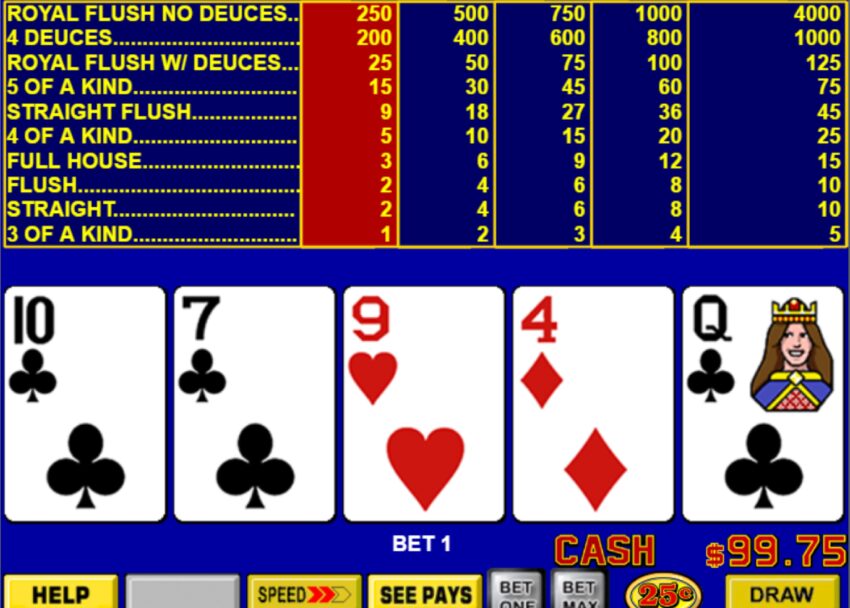
If you’ve ever sat down at a video poker machine, quarters clinking in your pocket and a glint of hope in your eye, you know the allure of Full-Pay Deuces Wild. For a golden era, this game was the holy grail for advantage players—those rare gamblers who could turn the casino’s edge into their own with enough skill and discipline. With perfect strategy, a modest bankroll of $100 or $200 could keep you in the game for hours, recycling your winnings like a well-oiled machine. But like all good things in the gambling world, the casinos caught on, and Full-Pay Deuces Wild began its slow fade into obscurity. Let’s take a walk through its evolution, its glory days, and its near-extinction—along with a nod to what advantage players can do to keep rolling with the punches.
The Golden Age of Full-Pay Deuces Wild
Back in the late 1990s and early 2000s, Full-Pay Deuces Wild was a staple in casinos across Las Vegas and beyond. Known for its 100.76% expected return with perfect play, it was one of the few games where skilled players could hold a mathematical edge over the house. The “full-pay” moniker referred to its generous paytable: 9/5 (9 coins for a full house, 5 for a flush on a 5-coin bet), with a payout structure that rewarded holding those wild deuces just right. For a $100 bankroll, you could sometimes grind for hours, hitting four-of-a-kinds, wild royals, and the occasional four deuces, watching your credits ebb and flow but rarely vanish.
What made Deuces Wild so special? The game’s volatility was a feature, not a bug. With four wild cards in the deck, big hands came often enough to keep you in the game, and perfect strategy—memorized through charts or drilled through software—meant you could sometimes stretch that $100 into an all-day affair. During the financial crisis of 2008–2010, when savings accounts paid a measly 0.1% interest, Full-Pay Deuces Wild’s expected return of around 0.76% to 2% (depending on comps and promotions) was a revelation. For advantage players, it was like finding a glitch in the matrix—a way to beat the system while sipping free coffee at the casino bar.
The Casinos Catch On
But casinos aren’t in the business of losing money. By the mid-2000s, the suits on the floor started noticing the players who lingered too long at the Deuces Wild machines, playing with surgical precision and racking up comps. Advantage players weren’t just winning; they were exploiting the system with perfect strategy, disciplined bankroll management, and a knack for sniffing out the best machines. Video poker groups, like the legendary vpFREE, became virtual campfires where players shared sightings of Full-Pay Deuces Wild machines, especially the coveted dollar-denomination ones that offered bigger payouts for the same edge.
The first blow came when dollar Full-Pay Deuces Wild machines started vanishing. By the early 2010s, they were as rare as a desert oasis, with players reporting their locations like birdwatchers spotting an endangered species. Quarter machines held on a bit longer, tucked away in locals’ casinos or off-Strip haunts, but even those began to dwindle. Casinos, increasingly savvy about “advantage play,” started pulling these machines from the floor entirely. You’d walk into your favorite joint, ready to grind, only to find your beloved Deuces Wild replaced by a 7/5 paytable or, worse, some soul-crushing slot machine.
The Crackdown on Advantage Players
It wasn’t just the machines that took a hit—players did, too. Casinos began spotting advantage players with the precision of a hawk. The “suits” patrolling the floor weren’t just checking for drunks or card counters; they were eyeing anyone who played too perfectly, too long, or too profitably. Free rooms, meals, and other comps—once a perk for loyal players—started drying up for those flagged as advantage players. In some cases, casinos outright banned players who consistently beat the game, their names whispered in backrooms like fugitives on a most-wanted list.
The math was simple: even though perfect-play Deuces Wild players were a tiny minority of gamblers, their edge was enough to dent the casino’s bottom line. Unlike slots, where the house edge is ironclad, or table games, where mistakes are common, Full-Pay Deuces Wild rewarded skill too well. And casinos don’t like losing, even a little.
Bob Dancer’s Warning and the Shift to NSUD
As early as the mid-2000s, video poker luminary Bob Dancer saw the writing on the wall. In posts on vpFREE and other forums, he warned that Full-Pay Deuces Wild was becoming an endangered species. His advice? Pivot to “Not So Ugly Deuces” (NSUD), a slightly less lucrative paytable (typically 16/10/4/4/3) that still offered a near-positive or slightly positive return with perfect play. NSUD required a more complex strategy than Full-Pay Deuces, but it was a lifeline for advantage players willing to adapt. Dancer’s foresight was prophetic: by the late 2010s, Full-Pay Deuces Wild was all but extinct, while NSUD machines lingered in a few strongholds.
The Lesson: Adapt or Bust
Today, Full-Pay Deuces Wild is a relic, a bittersweet memory for those who once turned $100 into hours of play and a small but real profit. Its disappearance is a stark reminder of the ongoing cat-and-mouse game between advantage players and casinos. The house always has the upper hand—they can change paytables, pull machines, or tighten comps at will. But advantage players aren’t defenseless. The key is to stay nimble: learn the strategies for the games that are still out there, whether it’s NSUD, Double Bonus, or another beatable paytable. Don’t get too attached to one casino, either—they’re watching, and they’re not sentimental.
For those still chasing the edge, resources like vpFREE2, Wizard of Odds, or Bob Dancer’s books offer the tools to find playable games and master their strategies. The Mystic Gambler’s advice? Roll with the punches. The days of Full-Pay Deuces Wild may be gone, but the spirit of advantage play lives on. Keep your eyes open, your strategy sharp, and your bankroll ready—because in the world of video poker, the next opportunity is always one shuffle away.

